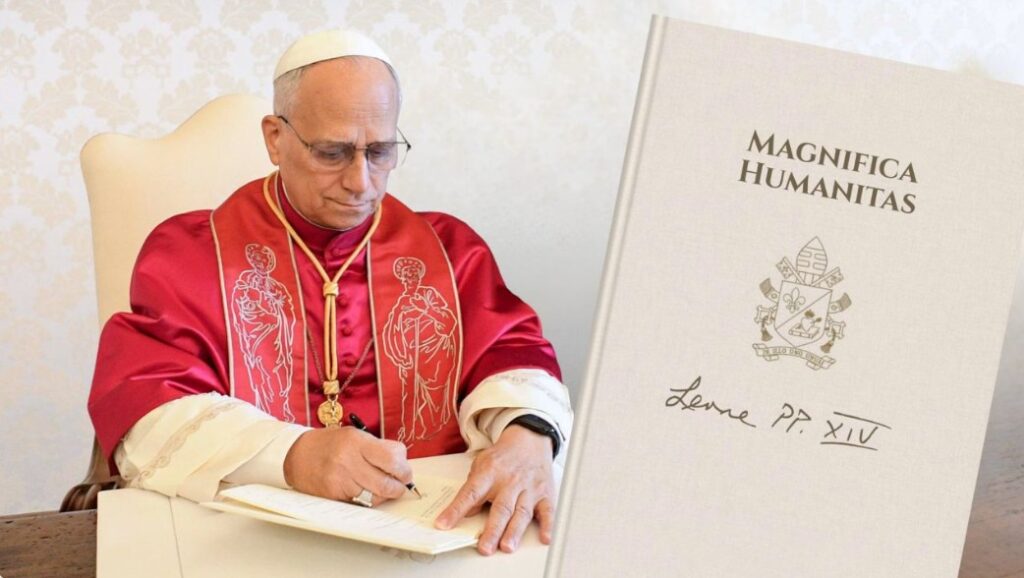
By Editorial Team | May 25, 2026 | Faith, Technology, Culture, Human Rights
Meta Description: Magnifica Humanitas, Discover everything about Magnifica Humanitas — Pope Leo XIV’s landmark encyclical released May 25, 2026, on human dignity, AI, and the future of humanity. A must-read guide to the most important document of 2026.
Introduction: A Moment the World Has Been Waiting For
On May 25, 2026, something extraordinary happened at the Vatican’s Synod Hall in Rome. Pope Leo XIV formally released Magnifica Humanitas — Latin for “Magnificent Humanity” — his first encyclical letter, and arguably one of the most powerful moral documents of the 21st century.
In a world overwhelmed by the lightning speed of artificial intelligence, consumed by questions about who AI serves and who it leaves behind, and hungry for a moral framework that can match the scale of technological transformation, Pope Leo XIV answered the call. Magnifica Humanitas is not simply a religious document. It is a luminous, sweeping declaration of what it means to be human — and a courageous, compassionate roadmap for ensuring that the AI revolution lifts all of humanity rather than diminishing it.
This is the encyclical the world needed. And today, it finally exists.
Whether you are Catholic, Christian, a person of another faith tradition, or simply a thoughtful human being trying to navigate an increasingly complex technological world, Magnifica Humanitas offers something rare and precious: clarity, hope, and a vision rooted in the irreducible dignity of every person.
Let’s explore every remarkable dimension of this landmark document — what it says, why it matters, and why it has captured the attention of believers, ethicists, technologists, and leaders across the globe.
1. What Is Magnifica Humanitas? Understanding the Document
Magnifica Humanitas — officially titled “On Safeguarding the Human Person in the Time of Artificial Intelligence” — is the first encyclical of Pope Leo XIV’s pontificate. An encyclical is one of the highest and most authoritative teaching documents a pope can issue — a formal letter addressed not just to Catholics, but, in this case, “to all the Catholic faithful, to all Christians and to men and women of goodwill.”
Pope Leo XIV signed the encyclical on May 15, 2026, a date of profound historical significance: the 135th anniversary of Rerum Novarum, the landmark 1891 encyclical by his namesake, Pope Leo XIII, which laid the foundation of modern Catholic social teaching in response to the Industrial Revolution.
The timing is intentional and deeply meaningful. Just as Pope Leo XIII faced the upheaval of industrialization — the displacement of workers, the concentration of wealth, the erosion of human dignity in factories — Pope Leo XIV faces an equally transformative moment: the rise of artificial intelligence. By signing Magnifica Humanitas on the anniversary of Rerum Novarum, he places his teaching firmly within a 135-year tradition of the Church insisting that people must always come first, no matter what economic or technological forces are reshaping the world.
The document is structured across 245 paragraphs in an introduction and five chapters. The first two chapters ground the encyclical in the rich history of Catholic Social Doctrine, tracing the tradition from Leo XIII through the Second Vatican Council and the recent magisterium. Chapter Three introduces “the technocratic paradigm” of AI and the imbalance of digital power. Chapter Four — perhaps the most practically urgent — addresses the safeguarding of truth, democracy, work, education, and human freedom in the age of AI. And Chapter Five turns its gaze toward peace, war, and the concentration of global power in the digital age.
2. The Brilliant Choice of Title and Its Deep Meaning
The title Magnifica Humanitas — “Magnificent Humanity” — is both a statement and an invitation.
It is a statement because it refuses the defeatism that so often colors conversations about AI. In public discourse, humanity is frequently portrayed as fragile, threatened, even obsolete in the face of artificial intelligence. Magnifica Humanitas boldly rejects this narrative. Humanity is not a problem to be solved or a limitation to be transcended — humanity is magnificent. Created in the image of God, endowed with reason, freedom, conscience, and love, human beings possess a dignity that no algorithm can replicate, no data set can capture, and no machine can replace.
It is an invitation because it calls every reader — regardless of faith — to see themselves and others through this lens of magnificence. When we recognize the inherent grandeur of every human person, we naturally ask different questions about technology: not just “what can AI do?” but “what does AI do to human beings? Does it serve their dignity or diminish it?”
Pope Leo opens the encyclical with this powerful framing: “Humanity, created by God in all its grandeur, is today facing a pivotal choice: either to construct a new Tower of Babel or to build the city in which God and humanity dwell together.”
The image of the Tower of Babel is potent. It represents a humanity so dazzled by its own power that it overreaches — building systems that ultimately divide and confound rather than unite and uplift. The alternative vision — rebuilding Jerusalem, as the encyclical puts it — represents technology oriented toward the common good, toward human connection, toward justice and peace.
The choice between Babel and Jerusalem is one every technologist, policymaker, investor, and ordinary citizen faces today. Magnifica Humanitas provides the moral compass to choose wisely.
3. The Historic Connection to Rerum Novarum: A 135-Year Legacy of Courage
To truly appreciate Magnifica Humanitas, it helps to understand the tradition it stands within — because that tradition is one of the most inspiring stories in modern moral history.
In 1891, Pope Leo XIII faced a world in crisis. The Industrial Revolution had transformed economies and societies with breathtaking speed, but the benefits were deeply unequal. Workers labored in brutal conditions for poverty wages. Children worked in factories. The dignity of human labor was systematically exploited in the name of profit. Into this moment, Pope Leo XIII released Rerum Novarum — “Of New Things” — a document that defended workers’ rights, condemned exploitative conditions, affirmed the value of human labor, and articulated principles of solidarity and justice that would influence social policy around the world for generations.
Now, 135 years later, history rhymes. The AI revolution is transforming economies and societies with equally breathtaking speed, and the benefits are again deeply unequal. Questions about who controls AI, who profits from it, who is surveilled by it, and who is displaced by it are the defining justice questions of our moment.
By choosing to sign Magnifica Humanitas on the anniversary of Rerum Novarum, Pope Leo XIV is saying something profoundly hopeful: the Church has been here before, and it has the wisdom, the courage, and the enduring commitment to human dignity to rise to the challenge again.
The encyclical explicitly situates itself within the lineage of Rerum Novarum, Centesimus Annus, and Laudato Si’ — building on each document’s contribution to Catholic social teaching while extending it boldly into new territory. This is a living tradition, not a static one, and Magnifica Humanitas is its most vibrant contemporary expression.
4. The Core Message: Technology Must Serve Humanity, Not Master It
At the heart of Magnifica Humanitas is a principle that is at once simple and revolutionary: technology is never neutral.
Pope Leo writes with striking clarity: “Technology is never neutral, because it takes on the characteristics of those who devise, finance, regulate and use it.” This means that AI systems do not simply emerge from mathematical equations — they are shaped by the values, interests, and choices of the human beings who build and deploy them. Every design decision reflects a vision of humanity.
This is a profoundly empowering insight. It means that AI’s impact on human dignity is not inevitable — it is chosen. And if it is chosen, it can be chosen differently.
The encyclical identifies a range of urgent concerns: job insecurity and displacement, the manipulation of information and disinformation, privacy violations and surveillance, ideological bias embedded in algorithms, the development of autonomous weapons, and the troubling vision of “enhanced” posthuman beings who have transcended ordinary human limitations.
But Pope Leo’s most important warning goes deeper than any of these specific issues. He identifies a danger that underlies all of them: the risk that human beings will begin to see themselves and others merely as data points, labor units, or instruments of control — that the dignity of persons will be eroded not through dramatic acts of violence, but through the quiet, systemic reduction of human beings to their measurable, optimizable properties.
This is what the encyclical calls the “anti-human vision” — a world built not around the flourishing of persons, but around the efficiency of systems. Against this vision, Magnifica Humanitas sets the magnificent alternative: a world where technology is genuinely, faithfully, consistently oriented toward the good of every human being.
5. The Remarkable Call for Social Justice in the Digital Age
One of the most inspiring and practically urgent sections of Magnifica Humanitas is its treatment of social justice in the digital era.
Pope Leo XIV makes clear that in the digital age, social justice requires a new and expanded commitment. It means ensuring fair access to opportunities for all people — because an AI-powered world that concentrates its benefits among the already-privileged and imposes its burdens on the already-vulnerable is not a just world, no matter how technologically sophisticated it is.
The encyclical specifically names migrants, refugees, and displaced persons as a “litmus test” for social justice — a challenge to measure how seriously any society takes the dignity of the most vulnerable. It calls for protecting the most vulnerable from algorithmic discrimination, combating hatred and disinformation that travels at digital speed, and ensuring that technologies are subject to meaningful public oversight. The guiding principle, Leo insists, must not be “solely profit but the dignity of every person and the common good of all people.”
This is not abstract moral philosophy. It has immediate, practical implications for how AI systems are designed, regulated, deployed, and governed. The encyclical calls for “shared standards of social justice” to be implemented across the technology sector — and AI developers, in particular, are called to recognize that they “bear a particular ethical and spiritual responsibility, for every design choice reflects a vision of humanity.”
For anyone who has felt that the AI revolution was happening to them rather than for them, these words are both validating and energizing. Magnifica Humanitas insists that ordinary people have not just the right, but the responsibility, to participate in shaping the technological future.
6. The Inspiring Tolkien Connection: Wisdom From Middle-Earth
One of the most delightful and widely celebrated moments in Magnifica Humanitas is Pope Leo XIV’s quotation of J.R.R. Tolkien — specifically from The Lord of the Rings: The Return of the King.
In Paragraph 213, the Pope draws on the wisdom of Tolkien, the beloved 20th-century Catholic author, writing that it is “small and steadfast acts of fidelity that serve as a bulwark against dehumanization.”
The Tolkien reference is not merely a charming literary flourish — it is theologically and morally significant. Tolkien’s great theme is precisely the power of ordinary people, acting with faithfulness and courage in their own small sphere, to resist overwhelming darkness. The hobbits of the Shire do not defeat Sauron through spectacular displays of power — they resist through endurance, friendship, fidelity, and the refusal to be defined by the magnitude of the forces arrayed against them.
This is exactly the posture Pope Leo commends to humanity in the age of AI. The challenges are vast — the concentration of AI power in the hands of a few, the erosion of truth, the displacement of workers, the militarization of technology. But the response does not require extraordinary individuals with extraordinary power. It requires ordinary people, living with integrity, making faithful choices, building genuine communities, and insisting on the humanity of every person they encounter.
Pope Leo also draws inspiration from Tolkien’s fellow Catholic and creative contemporary, Viktor Frankl; from philosopher Hannah Arendt; from Martin Luther King Jr.; and even from musical genius Beethoven — a remarkable, humanistic gathering of voices in service of a single compelling vision. That the Pope named Tolkien, whose work has inspired millions of readers worldwide, has created an especially warm and enthusiastic response across social media and among readers who might never have previously engaged with a papal document.
7. AI and Democracy: A Vital Warning and a Hopeful Path Forward
Chapter Four of Magnifica Humanitas may be the most immediately relevant for civic and political life. Pope Leo XIV addresses directly the threat that AI poses to democracy, truth, and freedom — and does so with both courage and constructive hope.
The encyclical recognizes that artificial intelligence, deployed without adequate oversight or ethical grounding, can weaponize disinformation at unprecedented scale. When algorithms optimize for engagement rather than truth, when deepfakes blur the line between reality and fabrication, and when digital platforms amplify division and fear, the foundations of democratic life are genuinely threatened.
Pope Leo’s response is not despair — it is the bracing, energizing call for a more active political engagement. He writes that what is needed is political involvement “capable of slowing things down when everything is accelerating, and of protecting the opportunities for communities still to be able to participate and ask questions.”
This is a beautiful and important insight. The pace of technological change is itself a political and moral issue. When AI systems transform labor markets, reshape information ecosystems, and alter the balance of geopolitical power faster than democratic institutions can understand or respond to them, that speed becomes a form of disenfranchisement. Magnifica Humanitas calls for a genuinely human-paced deliberation — one that respects the need of communities to understand, participate in, and shape the decisions that affect their lives.
This is not anti-technology. It is profoundly, intelligently pro-human.
8. Work, Education, and Family: The Human Institutions Worth Protecting
Among the most practically grounding sections of Magnifica Humanitas are its reflections on work, education, and family life in the age of AI — the three domains of ordinary human experience most directly touched by technological transformation.
On work, Pope Leo draws directly on the tradition of Rerum Novarum and Laborem Exercens, insisting that labor is not merely an economic activity — it is an expression of human dignity and creativity. When AI displaces workers without adequate attention to their well-being, development, and participation in a renewed economy, it violates something sacred. The encyclical calls for economic transitions that protect workers, invest in retraining, and distribute the productivity gains of AI in ways that benefit all.
On education, the encyclical sees both extraordinary opportunity and genuine risk. AI can democratize access to knowledge in remarkable ways — giving students in under-resourced communities access to personalized, high-quality learning. But it can also subtly undermine the irreplaceable human relationships at the heart of genuine education: the teacher who knows a student’s particular gifts, the mentor who models intellectual courage, the community that forms character alongside skill. Magnifica Humanitas insists that education must remain fundamentally human, even as it wisely embraces useful technology.
On family life, the Pope observes that the digital environment is reshaping how families relate, communicate, and form identity in ways that deserve thoughtful attention. Technology that fosters genuine connection, protects the family from harmful content, and supports parents in their formative role is welcome. Technology that substitutes for real relationship, exposes children to exploitation, or fragments the family’s shared life must be resisted.
9. Pope Leo XIV: The Perfect Pope for This Historic Moment
Understanding Magnifica Humanitas fully requires appreciating the remarkable man behind it.
Pope Leo XIV — born Robert Prevost — is the first American-born pope in history, though he holds dual U.S.-Peruvian nationality. He was elected in the 2025 conclave and has quickly established himself as a pope of extraordinary intellectual depth, pastoral warmth, and courageous moral clarity.
His choice of the name “Leo” was itself a statement of intent — a direct reference to Leo XIII and his tradition of engaging fearlessly with the great social questions of the age. From the beginning of his pontificate, Pope Leo XIV made clear that the AI revolution would be central to his teaching ministry.
His first apostolic exhortation, “Dilexi Te” (“I Have Loved You”), signed in October 2025, established his pastoral tone. Magnifica Humanitas now establishes his intellectual and social legacy. The document was presented at the Vatican’s Synod Hall alongside Christopher Olah, co-founder of Anthropic and pioneer of the field of mechanistic interpretability — a remarkable signal of the Pope’s commitment to genuine engagement with the technology community rather than simple condemnation from the outside.
Pope Leo XIV is not afraid of technology. He is asking the right questions about it — and his encyclical invites the entire world to ask those questions alongside him.
10. Why Magnifica Humanitas Matters for Everyone — Believer or Not
Perhaps the most beautiful thing about Magnifica Humanitas is that its vision transcends any single faith tradition.
The encyclical is addressed to all people of goodwill. Its core argument — that every human being possesses irreducible dignity, that technology must serve persons and not merely systems, that social justice requires fair access to the benefits of technological progress, and that ordinary communities have both the right and the responsibility to shape the technological future — is not an argument that requires Catholic faith to accept.
It is a humanist argument in the deepest sense. It is grounded in the conviction, shared across many philosophical and religious traditions, that there is something about being human that cannot be reduced to data, optimized by algorithms, or replaced by machines. That conviction is the foundation on which a genuinely just and flourishing technological society must be built.
At a moment when graduates are booing AI references at commencement ceremonies, when workers are anxious about displacement, when families are navigating the disorienting effects of digital life on their children, and when policymakers are scrambling to craft regulations for systems they barely understand, Magnifica Humanitas offers something rare: a coherent, hopeful, and morally serious framework for the conversation we all need to have.
It is not the last word. But it may be the most important word spoken so far.
Conclusion: A Magnificent Gift to Humanity
Magnifica Humanitas arrived today — May 25, 2026 — and the world is already responding with curiosity, gratitude, and hope.
It is a document that dares to call humanity magnificent at the very moment when so many forces — economic, political, and technological — seem to be working to diminish that magnificence. It insists on dignity when the systems around us are reducing people to data. It champions solidarity when algorithms are optimizing for division. It calls for wisdom and restraint when the pace of change is outrunning human understanding. And it grounds all of this in a tradition that has been wrestling with the relationship between technology, power, and human flourishing for more than 135 years.
Pope Leo XIV has given the world a precious gift. Whether you read it as a Catholic receiving your Church’s highest teaching, as a Christian engaging seriously with its scriptural and theological richness, as an ethicist finding in it a serious philosophical interlocutor, or simply as a human being who believes that the AI revolution should serve the common good — Magnifica Humanitas speaks to you.
It speaks to all of us. Because it speaks for all of us.
And in doing so, it reminds us of something we should never forget: humanity is, and always will be, magnificent.
Sources: Vatican News, National Catholic Register, Religion News Service, America Magazine, EWTN News, OSV News, Ascension Press, Melbourne Catholic, The Motley Fool, Wikipedia — Magnifica humanitas
Tags: Magnifica Humanitas, Pope Leo XIV, papal encyclical 2026, AI and human dignity, Catholic social teaching, artificial intelligence ethics, Rerum Novarum, Tolkien encyclical, technology and humanity, human dignity AI, Pope Leo XIV encyclical, safeguarding human person AI
Word Count: ~3,050 words