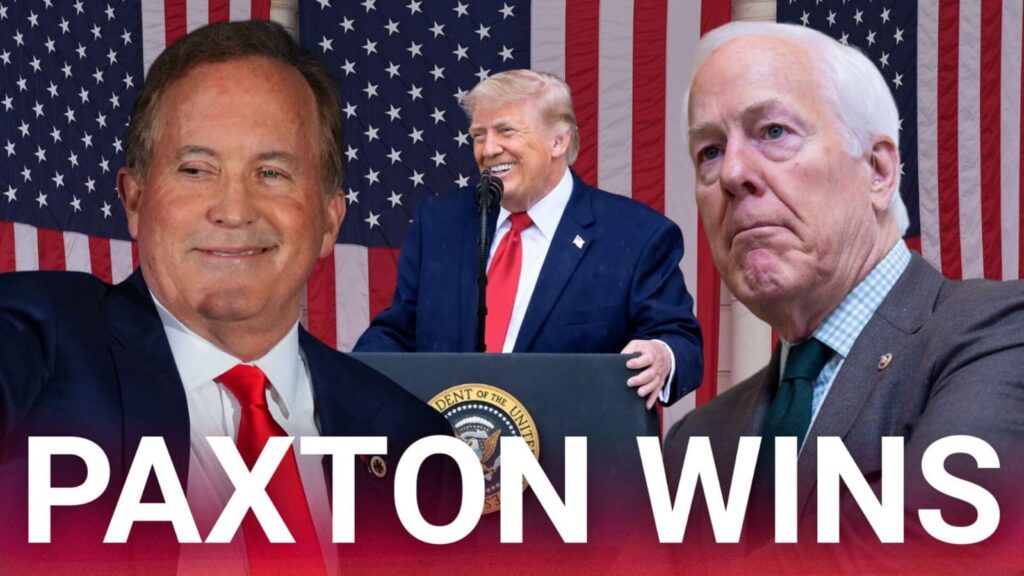
Unstoppable Force: Trump-Backed Ken Paxton Crushes John Cornyn in Seismic Texas Senate Upset — And Now the Real Fight Begins
A Night That Shook the GOP to Its Foundation
On the evening of Tuesday, May 26, 2026, at a packed victory party in Plano, Texas, a man who had survived impeachment, federal investigation, securities fraud charges, and a decade of political warfare walked onto a stage to the roar of an adoring crowd — and declared that Texas had just sent a message to Washington that could not be ignored.
“Tonight, we just sent a Texas-sized message to Washington,” Ken Paxton told his supporters as he soaked in the gravity of the moment. (The Texas Tribune)
He was right. What happened in Texas on May 26, 2026 is not just a primary result. It is a political earthquake — one whose tremors will reshape the Republican Party, the United States Senate, and the November general election in ways that no one fully anticipated. Attorney General Ken Paxton won the Republican primary runoff for U.S. Senate, ending over three decades of Senator John Cornyn’s electoral dominance in what amounts to a watershed moment for GOP politics in Texas. (The Texas Tribune)
This is the story of how Ken Paxton got here, what it means, and what comes next.
The Upset: Cornyn Falls After Three Decades
The Associated Press called the race for Paxton shortly after 8 p.m., about an hour after most polls closed in Texas. (The Texas Tribune)
The speed of the call told its own story. This was not a nail-biter. Paxton defeated Cornyn with 62 percent of the vote at the time the race was called. (Newsweek) A rout by any measure.
Cornyn becomes the first senator in Texas history to lose to a member of his own party since Ralph Yarbrough in 1970. (The Texas Tribune) Had Cornyn won the primary and gone on to serve a fifth term, he would have set a Texas senatorial record for longevity. Instead, he is a political casualty — not of a Democrat, not of scandal, but of a party that has changed dramatically beneath his feet.
Cornyn acknowledged the result with a mix of dignity and resignation, saying he has “always supported the Republican ticket and I intend to do so again in this general election,” though he conspicuously declined to mention Paxton by name. (NBC News)
For a man who built 24 years of Senate power through careful coalition-building, dealmaking, and loyalty to institutional Republicanism, this was a bitter end. Cornyn noted he votes with Trump “99.3% of the time,” framing Trump’s decision to endorse Paxton as a sign of the president’s broader frustration with the Senate itself — not with Cornyn specifically. (NBC News) Whether that is an accurate reading of events or a face-saving interpretation, it captures the central paradox of modern Republican politics: near-perfect loyalty to the president is no longer sufficient. What the MAGA base demands is a particular kind of fighting spirit, an aggression toward the left, and an enthusiasm for political warfare that traditional legislative statesmanship cannot replicate.
Paxton has that in abundance.
The Trump Factor: An Endorsement That Decided Everything
No analysis of this race is complete without confronting the decisive role played by President Donald Trump. For months, Trump refused to weigh in as Cornyn and Paxton battled through a bruising, expensive primary.
After Cornyn and Paxton advanced to the May 26 runoff, Trump announced on social media: “I will be making my Endorsement soon,” adding he would be “asking the candidate that I don’t Endorse to immediately DROP OUT OF THE RACE.” (Fox News)
The suspense stretched for weeks. Republican senators on Capitol Hill lobbied Trump intensively to back Cornyn, arguing that the four-term incumbent was more electable in November and that Paxton’s legal baggage made him a risky standard-bearer. Trump listened — and then did the opposite.
Trump ultimately announced his endorsement of Paxton on Truth Social, praising him as “a true MAGA Warrior who has ALWAYS delivered for Texas.” (Newsweek)
The impact was immediate and decisive. Paxton secured Trump’s endorsement just a week out from the runoff election and thanked the president during his victory speech, declaring: “His endorsement is the most powerful force in politics.” (CNN)
In the current Republican Party, that assessment is not hyperbole. It is simply accurate. Trump’s endorsement transformed a competitive race into a commanding victory, demonstrating once again that in 2026, the MAGA brand overpowers institutional loyalty, establishment spending, and decades of senatorial seniority.
Paxton praised Trump for endorsing him against the advice of Republicans in Washington. (The Texas Tribune) That framing — Trump standing with Paxton against the GOP establishment — was perfectly calibrated for the base that showed up to vote.
Who Is Ken Paxton? The Teflon Politician
To understand why Ken Paxton won this race, you must understand the extraordinary resilience of a man who has survived more political and legal crises than almost anyone in American politics.
Ken Paxton is the 51st Attorney General of Texas — the chief legal officer for a state of 31 million people and an office that has filed more lawsuits against the federal government over the last decade than any other state AG office in the country. Paxton was first elected in 2014 and re-elected in 2018 and 2022. (The Complete Lawyer)
His record as attorney general is formidable by conservative standards. Just weeks before the runoff, Paxton secured a major U.S. Supreme Court victory, successfully defending Texas’s congressional redistricting map for the 2026 midterms after lower courts had attempted to block it. “Radical left-wing groups attempted to sabotage Texas’s lawful redistricting efforts, but the Supreme Court’s ruling is a clear rejection of these meritless attacks and a victory for the rule of law,” Paxton declared. (Office of the Attorney General)
That kind of aggressive, combative posture — picking legal fights with the federal government, the courts, and liberal advocacy organizations — defines the Paxton brand. He is not a legislator by temperament. He is a warrior. And in 2026 Republican politics, warriors win.
But Paxton’s path to this moment has been anything but smooth. His career reads less like a typical political biography and more like a legal thriller.
A Decade of Legal Battles: Securities Fraud, Impeachment, and Survival
Ken Paxton’s legal saga began almost the moment he took office. Paxton was indicted on state securities fraud charges in 2015 — just months after being elected attorney general — accused of duping investors in a tech startup called Servergy in Dallas by failing to disclose the company had paid him to recruit them. (WFAA)
That indictment hung over Paxton for nearly a decade. For ten years, he served as the state’s chief law enforcement officer while himself under criminal indictment — an extraordinary situation that his critics never let him forget and that his supporters largely dismissed as a politically motivated prosecution.
Paxton ultimately agreed to pay nearly $300,000 in restitution under a deal to end the criminal securities fraud charges. (The Texas Tribune) Prosecutors subsequently filed a motion to dismiss the charges after Paxton completed a pre-trial diversion program, including 100 hours of community service. A judge in Harris County granted the motion, officially ending the decade-long legal saga. (WFAA)
But the securities fraud case was only the first chapter.
In 2023, Paxton faced the gravest threat of his political career: impeachment. The Texas House voted 121 to 23 in May 2023 to impeach Paxton on 20 articles tied to allegations that he had abused his office. He was suspended pending trial. (The Complete Lawyer)
The allegations were serious: Paxton was accused of misusing the powers of his office to provide preferential treatment to Austin real estate developer Nate Paul, a political donor who was under federal investigation. The impeachment articles alleged bribery, obstruction of justice, false statements, and a pattern of conduct involving misuse of his official position. (Ballotpedia)
The trial ran for ten days in September 2023. And then — in a result that stunned many observers — the Texas Senate acquitted Paxton on all 16 articles that reached a vote, with the highest tally at 14 senators voting to convict — far short of the two-thirds majority required for removal. (Ballotpedia)
After the vote, Paxton issued a statement calling the proceedings “a sham impeachment coordinated by the Biden Administration with liberal House Speaker Dade Phelan and his kangaroo court,” arguing it had cost taxpayers millions of dollars and left “a dark and permanent stain on the Texas House.” (Ballotpedia)
Then came the federal investigation. A parallel federal probe continued after the impeachment trial, but was quietly closed when the Justice Department declined to prosecute in the final weeks of the Biden administration. (Factually)
The result of all this turbulence? Paxton emerged from every legal and political battle — indictment, impeachment, federal investigation — not just intact but more powerful than before. Every survival story became a new chapter in the MAGA narrative of a fighter being persecuted by a corrupt establishment. His supporters did not see his legal troubles as disqualifying evidence of misconduct. They saw them as proof of his enemies’ desperation.
That political alchemy is what makes Paxton so difficult to stop.
The Most Expensive Primary in History
The Texas Senate race became the most expensive primary in history, with the Senate GOP campaign arm investing millions in the contest to defeat Paxton, and Senate Republicans believing it would be easier to defend the seat with Cornyn at the top of the ticket. (CBS News)
The money flowed almost entirely in one direction. Establishment Republicans and Washington-aligned super PACs poured resources into Cornyn’s campaign. Talarico, the Democratic nominee, raised more than $27 million in the first three months of 2026 alone, while Paxton brought in just $2.2 million in that same period — a staggering 12-to-1 fundraising gap that nonetheless failed to prevent his victory. (CNN)
What Paxton lacked in money, he made up for in something more valuable in a Republican primary: ideological alignment with the base, a reputation as an unflinching fighter, and ultimately, the president’s endorsement.
Paxton relied heavily on grassroots conservative enthusiasm while Cornyn and allied super PACs poured tens of millions of dollars into advertising. (MS NOW) The money did not matter. The base was not persuadable by television ads. They had already made up their minds.
Victory Night: The MAGA Warrior Speaks
Onstage at his victory party in Plano, Paxton took the stage to cheers from supporters and elected officials in his camp, praising Trump for endorsing him against the advice of Republicans in Washington. (The Texas Tribune)
His victory speech was a preview of what the general election campaign will look like — a full-throated MAGA offensive targeting his Democratic opponent and framing the race in existential terms.
“Texas will be the radical left’s number-one priority,” Paxton declared. “This campaign is not about red versus blue — it’s about so much more.” He added that his opponent, James Talarico, is “a threat to everything we hold dear in this state and in our country.” (CBS News)
In the aftermath of the victory, Texas Governor Greg Abbott and Senator Ted Cruz issued statements in support of Paxton, urging the party to come together to defeat Talarico in November. (CBS News)
Cornyn’s concession, notably free of Paxton’s name, signaled a party reconciliation that will be imperfect at best and strained at worst. The bitterness of the primary will not simply dissolve in the summer heat. Republican operatives who spent months attacking Paxton as uniquely unelectable will now be asked to fund, volunteer, and campaign for him. Some will. Some will not.
The Real Fight: November Against Talarico
The primary victory is enormous. But it is only the beginning of the battle that matters most.
Paxton will now face Democratic state Rep. James Talarico in the November general election in a seat national Democrats now have higher hopes of capturing. (MS NOW)
A Democrat has not won a U.S. Senate seat in Texas since former Sen. Lloyd Bentsen won his final race in 1988. (aol) That 38-year drought makes Texas the ultimate Democratic white whale — a state they have come close to flipping multiple times without ever actually doing it.
But 2026 may be different. Several factors converge to make this race genuinely competitive in a way that few Texas Senate races have been in a generation.
First, Talarico’s fundraising is extraordinary. He raised more than $27 million in just the first three months of 2026, making him one of the Democratic Party’s biggest fundraisers this entire cycle. (CNN) That financial advantage will allow him to blanket Texas’s expensive media markets with advertising while Paxton scrambles to build his campaign treasury from a much weaker fundraising base.
Second, polling shows a dead heat. A poll of 1,223 registered Texas voters conducted between April 22 and May 6 showed both candidates receiving exactly 45 percent of the vote — a statistical tie that underscores the genuine competitiveness of this race. (Newsweek)
Third, prediction markets — which aggregate real-money wagers from thousands of traders — tell a story of genuine uncertainty. Markets show Paxton with a 55 percent chance of winning versus Talarico at 45 percent — a slight Republican advantage, but one that reflects the tight, volatile nature of the contest. (Kalshi)
Paxton’s nomination also narrowed the Republican Party’s overall chances of retaining the Senate majority, with their odds of holding the chamber sitting at 52 percent — a number that shifted slightly as a result of Paxton’s win. (Kalshi)
Politico reported concerns from Republicans that Paxton’s nomination could force the party to spend massively to hold onto the seat, draining resources from other competitive battleground states. (Kalshi) That is precisely the scenario the establishment Republicans who backed Cornyn had warned about. Their warning was ignored. Now they will live with the consequences.
Paxton’s Vulnerabilities Heading Into the General
Ken Paxton enters the general election as the Republican nominee, but he carries a set of vulnerabilities that are unusual even by the standards of contemporary American politics.
His legal history — the decade-long securities fraud saga, the historic impeachment, the whistleblower lawsuits — gives Talarico and the Democratic Party an enormous opposition research archive to draw from. Unlike a primary electorate conditioned to see Paxton’s legal troubles as evidence of persecution, a general election audience includes independents and soft Republicans who may view those same facts less charitably.
Civil legal consequences have continued to accumulate even as criminal exposure faded, with reports of a ruling ordering Paxton to pay roughly $6.6 million to former attorneys who sued over retaliation after they reported misconduct. (Factually)
His dramatic fundraising disadvantage relative to Talarico means Paxton will need to rely heavily on national conservative donor networks, Trump’s orbit, and the RNC to remain competitive financially. That dependence gives the national party significant leverage over his campaign — and creates the awkward dynamic of a man who just defeated the Senate establishment now needing that same establishment’s money to win in November.
And then there is the broader political environment. Democratic enthusiasm is running high. The 2026 midterms are shaping up as a referendum on Trump and the Republican Congress, and a motivated Democratic base nationally will pour resources into a Texas Senate race that suddenly looks winnable.
What This Means Nationally
The reverberations of Paxton’s victory extend far beyond Texas. His win capped months of bitter campaigning that pitted establishment conservatives against the MAGA wing, exposing divisions inside the Republican Party that will not quickly heal. (MS NOW)
Paxton became the latest candidate to defeat an incumbent whom Trump deemed insufficiently loyal — a pattern that has defined the 2026 primary season and reshaped the ideological composition of Republican nominees across the country. (MS NOW)
For Senate Republicans watching from Washington, the Cornyn defeat sends an unmistakable message: no amount of legislative loyalty, seniority, or past service is sufficient protection against a Trump-backed primary challenger. If John Cornyn — with his 24 years of Senate experience and near-perfect Trump voting record — can be toppled, anyone can be toppled.
That reality will alter the behavior of every Republican senator. It will make them more deferential to the White House, less willing to exercise independent judgment, and more fearful of the grassroots conservative base that delivered this stunning result.
Conclusion: The Fighter Heads Into the Final Battle
Ken Paxton has spent his entire political career being underestimated, written off, and legally beleaguered — and he has spent that same career proving every prediction of his demise wrong.
He enters the general election as a wounded but dangerous nominee: financially disadvantaged, legally scarred, and facing a better-funded opponent in a state that is slowly but measurably shifting. The path to victory is real. So is the path to defeat.
What is not in question is Paxton’s will to fight. He has been fighting — against prosecutors, against impeachment managers, against Washington Republicans, and against every political obituary written about him — for over a decade.
The result on May 26 represents a triumph for Paxton and his wing of the GOP, which prioritizes politicians’ zeal for destroying the left over traditional values like statesmanship and dealmaking. (The Texas Tribune)
November will decide whether that philosophy can win a statewide general election in Texas. The state Republicans have held since 1994. The state Democrats have spent years dreaming of flipping. The state where, in one extraordinary election cycle, a man who faced impeachment, securities fraud charges, and federal investigation is now one general election victory away from the United States Senate.
Only in Texas. And only in 2026.
This article is based on reporting from The Texas Tribune, ABC News, CNN, CBS News, NBC News, Newsweek, NPR, and Kalshi prediction market data, current as of May 27, 2026.
Breaking
unstoppable Force: Trump backed Ken paxton crushes john cornyn in seismic Texas senate upset, now real fight begins